
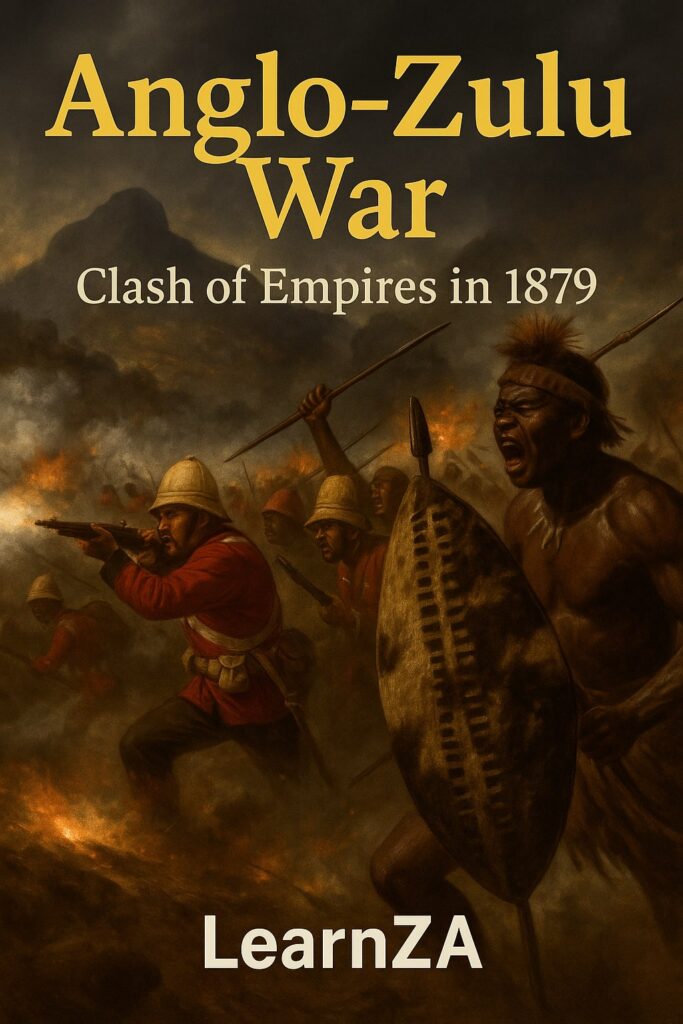
Introduction: A War That Redefined Southern Africa
Some wars leave behind scars. Others leave behind legends. And then there are wars like the Anglo-Zulu War of 1879 — conflicts so dramatic, so deeply human, and so violently decisive that they forever reshape the identity of nations. The clash between the British Empire and the Zulu Kingdom remains one of the most defining military encounters in African history: a war of courage, power, betrayal, pride, strategy, and unimaginable loss.
LearnZA Publishing’s powerful title, Anglo-Zulu War: Clash of Empires in 1879, retells this extraordinary moment with a narrative style that blends vivid description, historical accuracy, and compelling storytelling. For readers who want to understand the war beyond the simplified myths — for learners, educators, history lovers, and proud South Africans — this book offers a gripping journey across time.
👉 Get the book here:
https://learnza.co.za/product/1879-anglo-zulu-war-including-the-famous-battle-of-isandlwana/
In this article, we take you behind the scenes of the book — exploring the build-up to war, the rise of the Zulu nation, the British imperial ambitions, the famous Battle of Isandlwana, the heroic stand at Rorke’s Drift, and the tragic aftermath that shaped the future of the region.
Prepare for a historical journey that feels almost cinematic, yet grounded in truth.
The World in 1879: Britain Expands, Africa Resists
By 1879 the British Empire was at its peak. Its navy dominated global trade routes, its colonies stretched across continents, and its leaders were driven by a ruthless ambition to control every strategic region in southern Africa.
But the Zulu Kingdom — under the mighty leadership of King Cetshwayo kaMpande — stood in the empire’s way. The kingdom was disciplined, united, and proud, built on the military foundations laid decades earlier by King Shaka Zulu, perhaps Africa’s most feared military innovator.
The British authorities saw Zululand not as a sovereign nation but as an obstacle. To them, it was territory that needed to be “tamed” for their political and economic agenda in southern Africa. The famous British High Commissioner, Sir Bartle Frere, believed that the Zulus posed a threat to British control of Natal and the Transvaal — and so he crafted a plan to provoke war.
With manufactured reasons and an impossible ultimatum, the British set events in motion that would lead to one of the most dramatic wars ever fought on African soil.
The Zulu Kingdom: A Nation Built on Discipline and Unity
To understand why the Anglo-Zulu War was so monumental, one must understand the Zulu nation itself. By the time of the war, the Zulu military system — the impi regiments — was one of the most efficient war machines in Africa.
- Young men grew up in age-regiment systems
- They trained daily, fighting mock battles
- They developed unmatched endurance, capable of running long distances at high speed
- Their weapons were deadly at close range: the iklwa stabbing spear and the cowhide isihlangu shield
- Their battlefield tactics were legendary, particularly the formation known as the “Buffalo Horns”
This was not an “untrained tribal militia,” as the British propaganda suggested. It was an elite, disciplined army of hardened warriors motivated by loyalty, honor, and national pride.
The British Invasion: Confidence, Miscalculation, and Arrogance
When the British army crossed into Zululand in January 1879, they expected a quick victory. They marched with modern rifles, artillery, ammunition wagons, cavalry, and engineering support.
To London and to their officers on the ground, the war felt like a foregone conclusion.
But war has a way of humbling the confident.
And on a hot January morning at the foot of a strange mountain — Isandlwana — the greatest imperial shock of the century unfolded.
The Battle of Isandlwana: The Day the Empire Trembled
On 22 January 1879, one of the most astonishing military upsets in world history occurred.
The British camp at Isandlwana was spread across the plain without proper fortifications — a shocking breach of basic military logic. Their commanders underestimated the speed and strategic genius of the Zulu army.
What happened next defied expectations.
The Zulu Strategy: Brilliant, Fluid, Deadly
The Zulu army — nearly 20,000 warriors — advanced with astonishing discipline and silence, using the Buffalo Horn formation to surround the British position.
Despite facing modern rifles, the Zulus:
- Closed distance rapidly
- Absorbed heavy casualties
- Exploited gaps in the British lines
- Overwhelmed soldiers in brutal hand-to-hand combat
When the dust settled, over 1,300 British soldiers were dead — one of the greatest defeats in the history of the empire.
For the Zulu nation, it was a moment of triumph and pride.
For Britain, it was a humiliation that shook London to its core.
The book captures this moment not as dry military history but as a living, breathing human drama — the emotions, the fear, the courage, and the clash of two worlds.
Rorke’s Drift: Twenty Hours of Defiance
It is impossible to speak about the Anglo-Zulu War without mentioning Rorke’s Drift — the small mission station defended by just 150 British soldiers against 4,000 Zulu warriors on the very same day as Isandlwana.
Where Isandlwana exposed British arrogance, Rorke’s Drift showcased British discipline under pressure.
The defenders built improvised barricades of mealie bags and biscuit boxes. Through the entire night, wave after wave of Zulu warriors attacked. The British held firm, firing volley after volley.
By dawn, the Zulus withdrew, recognizing the defenders’ unbreakable determination.
This incredible stand saw 11 Victoria Crosses awarded, the most ever given in a single battle.
This duality — Zulu triumph at Isandlwana, British defiance at Rorke’s Drift — forms one of the most dramatic 24-hour periods in military history.
Aftershock: Britain Strikes Back
The British Empire does not lose twice.
After Isandlwana, London sent reinforcements with a vengeance. Entire regiments were shipped to South Africa. Artillery, Gatling guns (early machine guns), cavalry units, and thousands of infantry poured into Zululand.
The second invasion was ruthless.
The British:
- Burned homesteads
- Destroyed food reserves
- Captured cattle
- Chased impi regiments relentlessly
- Executed resistance leaders
Despite the bravery of the Zulu warriors, they could not withstand the overwhelming firepower.
The war reached its tragic end at Ulundi on 4 July 1879, where the British formed a defensive square and unleashed devastating rifle and artillery fire on the Zulu regiments.
The kingdom fell.
King Cetshwayo was captured.
Zululand was fragmented and placed under British control.
A War of Heroes and Lessons
LearnZA Publishing’s book focuses not only on battles but also on the human stories:
- Zulu bravery — warriors fighting for land, family, and sovereignty
- British soldiers — many young men drafted from poor backgrounds, caught in imperial ambitions
- Women and children who fled burning villages
- The political manipulation that started the war
- The cultural misunderstandings that defined British-Zulu relations
It is a story of two nations meeting at the crossroads of history — one fighting to expand empire, the other fighting to preserve identity.
Why This Book Matters Today
The Anglo-Zulu War is not just a historical military conflict. It is a lens through which we can understand:
- The history of colonial expansion
- The resilience and pride of the Zulu people
- The roots of modern South African social and political structures
- The human cost of imperial ambition
- How misinformation and arrogance can lead to catastrophic decisions
South Africans today live in a society shaped, in part, by the aftermath of 1879. Understanding that year is essential to understanding ourselves.
This is why LearnZA’s book is so powerful.
It does not sensationalize.
It does not sanitize.
It tells the story with balance, humanity, and emotional intensity.
👉 Get your copy today:
https://learnza.co.za/product/1879-anglo-zulu-war-including-the-famous-battle-of-isandlwana/
The Book’s Approach: Clear, Thoughtful, Engaging
LearnZA Publishing’s strength lies in transforming complex history into narrative that is:
✔️ Easy to read
No academic jargon — just clear storytelling.
✔️ Accurate and well-researched
Military movements, dates, leaders, and strategies are explained with precision.
✔️ Human-centered
The book emphasizes emotions, decisions, cultural contexts, and perspectives from both sides.
✔️ Educational
Perfect for learners, teachers, and anyone seeking a deeper understanding of southern African history.
Chapter Highlights Covered in the Book
While this article gives a broad overview, the book itself goes deeper into:
- The rise of the Zulu Kingdom
- Shaka’s military reforms
- British colonial strategy
- Political tensions in Natal
- The ultimatum designed to provoke war
- Detailed battle narratives
- Tactical diagrams
- Human stories from soldiers and warriors
- The fall of King Cetshwayo
- The long-term effects on South Africa
Every chapter is carefully structured to keep readers engaged while offering educational depth.
The Legacy of the Anglo-Zulu War
Today, the Anglo-Zulu War continues to inspire:
- Documentaries
- Films
- Historical tours
- Academic research
- Cultural commemorations
- School history projects
The Zulu are globally recognized for their courage.
The British regiments who fought at Isandlwana and Rorke’s Drift maintain museums and archives filled with artifacts and letters.
Descendants of warriors and soldiers still tell the stories.
This is not forgotten history.
It is living history.
Why You Should Read This Book
If you want to understand:
- The origins of Zulu pride
- The brutality of empire
- The story behind South Africa’s most famous battles
- The emotional weight of colonial conflict
- The courage shown by both sides
- The birth of legends that still echo today
…then this book belongs on your shelf.
The Anglo-Zulu War is not just a chapter in a textbook. It is a story of honor, tragedy, power, resistance, and the resilience of a nation that refused to be erased.
👉 Order your copy now:
https://learnza.co.za/product/1879-anglo-zulu-war-including-the-famous-battle-of-isandlwana/
Conclusion: A War That Still Speaks
More than 140 years later, the Anglo-Zulu War continues to fascinate the world. It is a reminder that:
- Empires rise and fall
- Courage is universal
- Cultures clash and reshape history
- Freedom is never guaranteed
- Identity survives even in defeat
LearnZA Publishing captures this truth with remarkable clarity in Anglo-Zulu War: Clash of Empires in 1879 — a book that retells the story with dignity, balance, and unforgettable detail.
History is not meant to be forgotten.
It is meant to be understood.
This book ensures that the legacy of 1879 lives on, honoring all who fought, all who died, and all whose stories deserve to be told.
👉 Buy the book today on LearnZA:
https://learnza.co.za/product/1879-anglo-zulu-war-including-the-famous-battle-of-isandlwana/
